HTTP/2: The Evolutionary Path to Modern Web Performance
After understanding HTTP/0.9, 1.0, 1.1 along with the basics of TCP and TLS, today we'll explore another major innovation in the HTTP protocol - HTTP/2.
As the first significant update in 18 years since HTTP/1.1, HTTP/2 fundamentally changes how clients and servers communicate, bringing substantial performance improvements to modern web applications.
Before discussing HTTP/2's improvements, we need to systematically examine the core performance limitations of HTTP/1.1:
-
Head-of-line blocking
Since HTTP/1.1 is implemented over TCP, requests/responses in the same TCP connection must be processed strictly in order. Because TCP can't distinguish which HTTP request a packet belongs to, if response A isn't fully received, subsequent request B must wait. This serial processing severely impacts concurrency. -
Header redundancy
Each HTTP request carries complete headers including repetitive fields like Cookies and User-Agent. This redundant data consumes bandwidth and increases latency. -
Connection concurrency limits
Browsers typically enforce 6-8 concurrent connections per domain to reduce server load. While domain sharding can help, it adds DNS lookup and TCP handshake overhead. -
No server push mechanism
The strict request-response model means servers can't proactively push resources. This passive approach forces clients to explicitly request each resource, preventing predictive pushing.
These limitations were acceptable for early static web pages but became significant bottlenecks for modern web apps (like SPAs with numerous fine-grained requests). As web resources grew in quantity and complexity, these inherent flaws in HTTP/1.1 led to HTTP/2's development.
While fully preserving HTTP/1.1 semantics (including request methods, status codes, header fields, etc.), HTTP/2 revolutionizes the transmission mechanism with key technical innovations:
Binary Framing Layer
The most groundbreaking change in HTTP/2 is shifting from text-based to binary protocol format. This design deconstructs traditional HTTP messages into fundamental units through framing:
-
Protocol Stack Relationship:
-
Serves as an intermediate layer between HTTP semantics and transport layer (TLS/TCP)
-
Operates independently from TLS record layer without strict one-to-one mapping
-
A single TLS record may contain multiple HTTP/2 frames, while a single frame may span multiple TLS records
-
-
Frame Type System:
-
HEADERS frame: Carries HTTP header metadata
-
DATA frame: Transports request/response entity content
-
PRIORITY frame: Enables stream priority control
-
RST_STREAM frame: Provides stream termination mechanism
-
PUSH_PROMISE frame: Supports server push
-
-
Transmission Mechanism Essence: Unlike HTTP/1.1's direct mapping of text messages to TCP segments, HTTP/2 introduces an intermediate abstraction layer:
-
Each logical request is assigned a unique stream ID
-
Messages are segmented into binary frame sequences carrying stream IDs
-
These frames can be multiplexed and interleaved over a single TCP connection
-
Ultimately still encapsulated via transport protocols like TLS, with no alignment requirement between frame boundaries and record boundaries
-
-
Technical Advantages:
-
Binary encoding significantly improves parsing efficiency
-
Frame structure provides foundational support for multiplexing
-
Stream ID mechanism perfectly resolves message attribution
-
Granular control enables superior resource scheduling
-
This layered design maintains compatibility with upper-layer HTTP semantics while achieving breakthrough performance optimizations at the transport layer, laying the groundwork for advanced features.
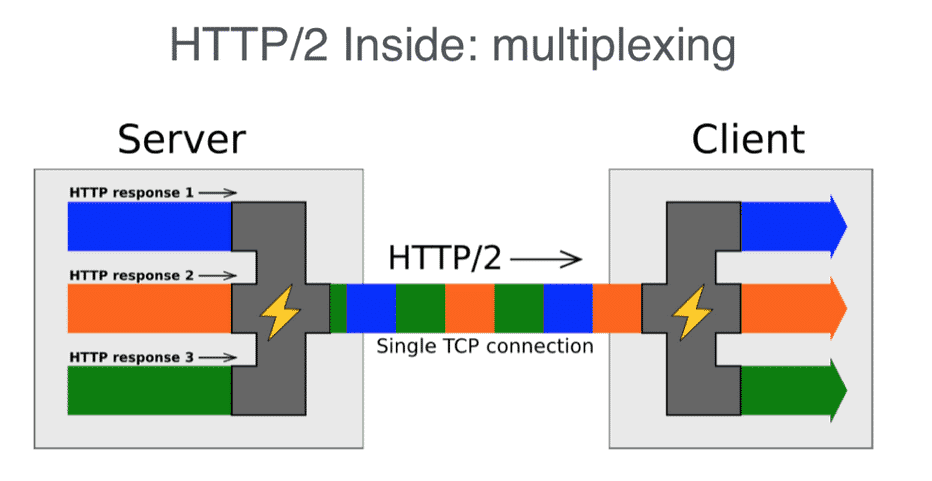
HTTP/2 fundamentally solves HTTP/1.1's head-of-line blocking issue through its innovative Stream mechanism. The core principles are as follows:
-
Basic Characteristics of Streams:
-
Each independent request/response interaction is assigned a unique Stream ID (a 31-bit integer).
-
Streams have a lifecycle, transitioning through specific states from creation to termination.
-
Streams are completely independent, allowing concurrent processing and transmission.
-
-
How Multiplexing Works:
-
Multiple active streams can coexist on a single TCP connection.
-
Frames from different streams can be interleaved and sent without waiting for prior streams to complete.
-
The receiving end reassembles out-of-order frames into complete messages using Stream IDs.
-
-
Transmission Process Illustration:
[Client]                                      [Server]
   | ----- HEADERS Frame (Stream ID=1) -----------> |
   | ----- DATA Frame (Stream ID=1, partial data) -> |
   | <---- HEADERS Frame (Stream ID=1) ------------- |
   | ----- HEADERS Frame (Stream ID=3) -----------> |
   | <---- DATA Frame (Stream ID=1) --------------- |
   | ----- DATA Frame (Stream ID=3) ---------------> |
   | <---- HEADERS Frame (Stream ID=3) ------------- |
| <---- DATA Frame (Stream ID=3) --------------- |-
Technical Advantages:
-
Eliminates application-layer head-of-line blocking: Slow requests no longer block others.
-
Maximizes connection efficiency: A single connection can handle all resource requests.
-
Reduces latency: Avoids the overhead of establishing multiple TCP connections (three-way handshake/TLS negotiation).
-
Better bandwidth utilization: Prevents wasted bandwidth due to connection contention.
-
-
Improvements Over HTTP/1.1:
-
Unlike HTTP/1.1's limit of 6-8 concurrent connections, HTTP/2 theoretically supports unlimited concurrent streams.
-
The actual number of streams is constrained by the flow control window on the implementation side.
-
Stream prioritization ensures critical resources are transmitted first.
-
This design allows web applications to achieve the efficiency of using multiple independent connections while avoiding the overhead of maintaining them—making it a cornerstone of modern web performance optimization.
The HPACK compression algorithm adopted by HTTP/2 represents a major breakthrough in HTTP header transmission, consisting of three core components:
-
Static Table Optimization
-
Predefines 61 high-frequency complete header field combinations
-
Includes common request headers (e.g.,
:method=GET) and response headers (e.g.,:status=200) -
Allows referencing complete headers with 1-byte indexes, for example:
Index 2 → :method: GET
Index 8 → :status: 200
-
-
Dynamic Table Mechanism
-
Maintains recently used header fields dynamically per connection session
-
Uses FIFO (First-In-First-Out) caching strategy with default 4KB size
-
Example dynamic update process:
Client first sends:
custom-header: example

Server stores in dynamic table after decoding (assigned index 62)
Subsequent transmissions only need to send: 62
-
Compression Efficiency Comparison:
- Typical request header compression case:
HTTP/1.1 Original (287 bytes):
GET /resource HTTP/1.1
Host: example.com
User-Agent: Mozilla/5.0
Accept: text/html

HTTP/2 Compressed (32 bytes):
82 86 84 41 8c f1e3 c2e5 f23a 6ba0 ab90 f4ff-
Key Technical Advantages:
-
Redundancy elimination: Repeated headers only transmitted once per connection
-
Binary encoding: Avoids HTTP/1.1 text format waste
-
Context maintenance: Dynamic table continuously optimizes subsequent request compression
-
This compression mechanism not only dramatically reduces data transmission volume but also significantly mitigates TCP slow-start impacts caused by oversized headers, proving particularly crucial for high-latency environments like mobile networks.
HTTP/2's server push feature revolutionizes the traditional "request-response" model with the following complete workflow:
-
Push Trigger Conditions
-
Server receives a main resource request (e.g., HTML)
-
Server predicts required associated resources (CSS/JS/images) based on business logic
-
Server verifies client cache status (via mechanisms like
Cache-Digest)
-
-
Push Protocol Interaction
[Client] [Server] | ---- GET /index.html ------------> | | <--- PUSH_PROMISE(style.css) ---- | | <--- PUSH_PROMISE(app.js) ------ | | <--- HTTP/2 HEADERS(index.html) - | | <--- HTTP/2 DATA(index.html) --- | | <--- HTTP/2 HEADERS(style.css) - | | <--- HTTP/2 DATA(style.css) ---- | | <--- HTTP/2 HEADERS(app.js) ---- | | <--- HTTP/2 DATA(app.js) ------- | -
Client Control Mechanisms
-
Negotiates push capability via
SETTINGS_ENABLE_PUSHparameter -
Can immediately respond to
PUSH_PROMISE:-
Accept push: Keep connection open
-
Reject push: Send
RST_STREAMframe
-
-
Smart cache validation: Pushed resources include validation info like
Etag
-
-
Performance Optimization Principles
-
Eliminates "discovery-request" latency in traditional model:
-